Friday, 30 October 2015

PALACES, PUDDLES AND PONIES

"Man at Work" statue in Bratislava
Its always interesting to learn about events that mold a nation.  Slovakia has had a chequered history but with the fall of communism in 1989 and the Velvet Revolution that split Czechoslovakia into the Czech Republic and Slovakia in 1993, positive changes started to take hold in this small nation.  Talk to anyone on the streets of Bratislava and they will tell you that in spite of all these tumultuous events it was Slovakia’s victory over Russia in the 2002 World Hockey Championships that unified the nation.  We understood perfectly.

Leaving Bratislava after a morning walking the cobbled streets of the Slovakian capital, we set sail for the Austrian capital of Vienna, just fifty miles away.  
 
Palais Pallavicini Reception Room
Arriving in Vienna that evening we were feted at the Palais Pallavicini, a privately owned palace across from the Hofburg. Welcomed with a champagne reception to the strains of Mozart and Strauss we were struck by the ornate interior, high ceilings and sparkling chandeliers. The scene was absolutely stunning.

Our violinist, cellist and pianist continued to entertain while dinner was served and wine flowed into the exquisite crystal glasses at each place setting.  Operatic performances and dancing followed.


They certainly knew how to put
on a performance.


The gardens of Schoenbrun
Schoenbrun Palace still stately
in the rain

The next morning we were greeted with grey skies and steady rain. 

All on MS Treasures hoped the rain would have a positive impact on the desperately low Danube water levels.  

We didn’t mind a seriously bad hair day.  

Our morning was spent enjoying the apartments and gardens of the Habsburgs summer palace at Schoenbrun.  A mini Versailles, the interiors are original but despite the rain, it was the gardens we were drawn to, expansive, colourful and symmetrical in their design.

Sacher Torte has its own food group
Returning to town it was time to indulge in a Viennese specialty at one of the landmark Vienna coffee houses, Café Sacher.  Never mind the rain, we luxuriated in chocolaty Sacher Torte accompanied by a double espresso and Apple Strudl as back up. Oh those calories, but what a delight.

A horse drawn carriage trots past the Hofburg Imperial Palace - how magical is that!
Time for a little exercise we walked to St. Stephen’s Cathedral, a 14th Century landmark.  Beautiful exterior, but a little gloomy inside, the dreariness of the day not helping matters. 


Strudl pastry being prepared
at Cafe Demel
One of the antique chocolate cabinets
Returning to the Hofburg we dropped by Café Demel to watch the pastry chefs in action - the strudl pastry a good six feet in length.  

The front of the house was another matter. Every seat taken, the aromas of coffee and chocolate palpable. The displays of intricately decorated cakes and strudl impressive and the array of chocolate not for the faint of heart.

The highlight of the afternoon was our visit to the Spanish Riding School and the stables of the Lipizzaner stallions.  The tack room amazing, the stables and their stars magical.

Lipizzaner stallions perform in the
Winter Riding School arena
Immaculate Tack Room
A little on the damp side, we decided to take the subway back to our riverboat.

We reflected that despite the miserable day it really hadn’t mattered.  

We had had a brilliant day.

Photographs not allowed in the stables, this fellow watched us from the courtyard

Wednesday, 28 October 2015

THERMAL BATHS AND SWEEPING VISTAS

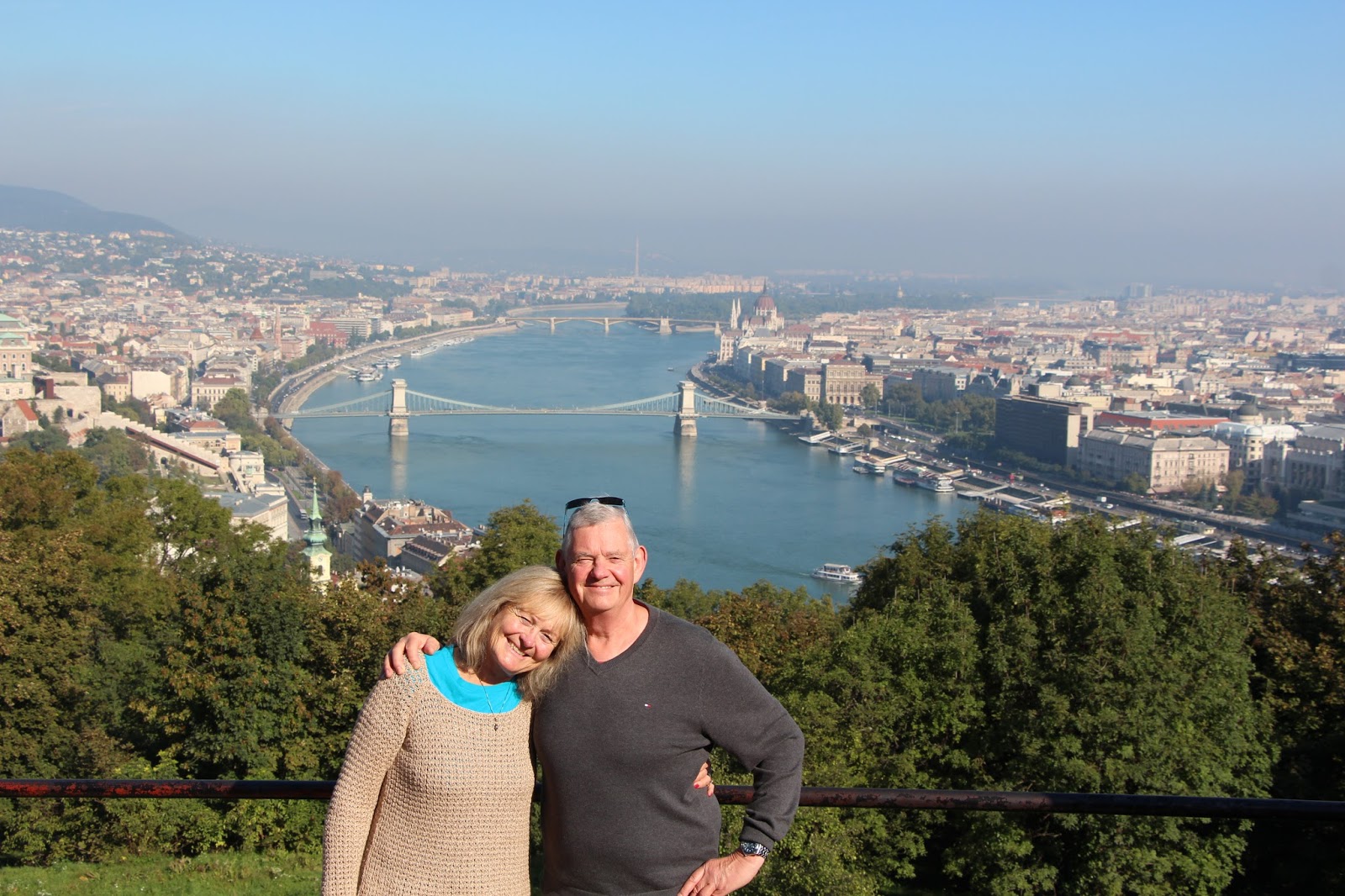
Sweeping panorama over the Danube from Gellert Hill
Orsi met us bright and early with Donny who would be driving us to various points around the city. 

Views from Gellert Hill and Liberty Monument offered wonderful views over the city, the Danube and its numerous bridges.

A tranquil residential district with beautiful gardens line the Gellert hillside, as Orsi put it, “five minutes from the happenings“.

The Hungarian State Opera House is one of Budapest's most attractive buildings.  Akin to a wedding cake in its design it was constructed when Hungary was part of the Austro-Hungarian Empire. Smaller than its Vienna counterpart, its interior is more elaborate, apparently much to the chagrin of Emperor Franz Joseph at the time. 


Elephant House at Budapest Zoo
Across from the Opera House and tucked away in a nearby pedestrian area is a statue of Hungarian composer Franz Liszt.  What is impressive about the statue is the movement the sculptor captured in Liszt’s hands and hair making it easy to visualize the virtuoso pianist in performance.

Passing Budapest zoo on our way to the Szechenyi Thermal Baths, we caught sight of the ornate Moorish-style Elephant House built in 1912.  Impressive digs for the pachyderms! 

Szechenyi Thermal Baths
Gellert Thermal Baths
A wealth of thermal spring-fed baths grace the city but the lavish baths of Szechenyi and Gellert each have impressive 19th century settings to showcase their indoor and outdoor pools. Both venues were busy with patrons, some arriving for medically required treatments, others for the pure enjoyment. At Szechenyi groups of male bathers congregated at one end of the outdoor pool to play chess while relaxing in the steamy waters. 

New York Coffee House
The New York Coffee House is another one of those must-see and experience coffee houses in Budapest. The New York Café began life in 1894 as part of the New York Palace, named for the New York Life Insurance Company who owned the building. From the beginning it was a magnet for the city’s writers and artists to meet and exchange ideas. The Italian renaissance interiors are nothing short of eye popping - the honey infused café latte not to be overlooked amidst the Baroque glamour.

Parliament Building from Fishermen's Bastion
On the Buda side of town, Castle Hill, now a UNESCO World Heritage Site, bears the influences of the Magyars, Turks and Hapsburgs. After a healthy climb we were rewarded with more excellent views over the Danube from the turreted Fishermen’s Bastion. The colourful tiles on the roof of Mathias Church gleamed in the sun as we explored the winding cobbled streets and Baroque buildings, many of which are private residences. 

 
Enjoying the view from Castle Hill
Driving back to the Pest side of town we strolled the square in front of the Parliament Building.  Eclectic and quite beautiful, the structure combines a blend of architectural styles. Recognizable as the building featured in Budapest’s promotional tourism material it is a one of a kind. It is said that when Freddie Mercury of Queen saw the building he wanted to buy it!

Sun shining through the honey display
After a vigorous walk from Parliament, one final culinary experience awaited at the Szimpla Sunday Farmers’ Market hidden away in the Jewish Quarter amidst a crowded courtyard. Live music created a Bohemian feel as we engaged in some serious cheese tasting, followed by deer salami and spectacular organic honey.  

Orsi was determined we should try the deep fried Langos, missed the previous day.  Topped with generous amounts of cheese and sour cream we obliged somewhat reluctantly, sharing a flat bread, but deciding that Hungarians must be made of stern stuff. 

Orsi presented us with a final culinary offering that came in the form of a frozen chocolate bar - cottage cheese coated in dark chocolate.  We were now craving fresh fruit and broccoli, our systems wondering what on earth had been going on these past few days.

Saying goodbye to our wonderful Budapest guide Orsi, we joined the riverboat later that afternoon for the two-week 1150 mile journey along the Danube, Main and Rhine rivers to Amsterdam that will take us through 68 locks, water levels permitting.  

As we packed our things away we did question the decision to purchase a couple of our tastings to bring home.  Labelled in Hungarian, we were now a little fuzzy as to what we had bought.  Thank goodness for Google translator. The Rocket Pumpkin Cream and Truffled Plum Balm will be much enjoyed, now that we have been reminded what they are!

Monday, 26 October 2015

THANKS TO ORSI, WE DIDN'T GO HUNGRY IN HUNGARY

This experience leaves Starbucks in the dust
Budapest is full of surprises. Imposing buildings in all sorts of architectural styles line both sides of the Danube.  Linked together by a series of bridges,  the hills of Buda and the flatlands of Pest form the city that is Hungary’s capital.  

Cosmopolitan, sophisticated yet a little faded in parts, the city has many faces. Emerging from a long history of occupation and repression, after the fall of the Iron Curtain in 1989 a Hungarian renaissance has emerged.

We met our local guide Orsi to begin our discovery of the city, walking the nooks and crannies of Pest.  She introduced us to Budapest's coffee culture which dates back over 150 years. Some of the coffee houses look as though they have been frozen in time, high ceilings, magnificent fixtures, mirrors and glass and of course the coffee and exquisite cakes.  The Gerbeaud Café and Confectionary in Vorosmarty Square likely the grand dame of them all.

Chimney Cake
Finally a pronounceable name !
This was just the beginning of our morning with Orsi.  A culinary tour like no other.  A tasting of artisan cheese, chutneys, mustards, jams and fruit brandy produced organically and sold at Balaton Izlelo. Cardamom, tarragon and lavender flavoured chocolates from Green Hat - and then a revelation.

The Trdelnik we had enjoyed in Prague apparently originates from Transylvania and is a Hungarian speciality called Kurtoskalacs or Chimney Cake. A baker gave us a personal demonstration.  Made from sweet dough spun around a cone-shaped baking spit and rolled in granulated sugar the dough is baked above charcoal cinders until it is golden brown. The sugar turns into caramel and toppings of ground walnut and cinnamon are added.

Budapest's Central Market
Our next stop was the lively Central Market Hall with three floors to discover.  The sampling continued with pungent cheeses, salami of all kinds - particularly good the Mangalica - pork from the Hungarian woolly pig.  


A mecca for foodies
All manner of pickles, cabbage strudl, and what can only be described as pork scratchings.  Our cholestrol count rising rapidly it was probably fortunate the line up for the Langos, deep fried flat bread with sour cream, garlic and cheese, was a little too long.  We left the frenetic atmosphere of the Market for our official lunch stop.  

Enough to feed an army.  Quite possibly one sausage too far.
A tram ride later we arrived at Belvarosi Disznotoros, a butcher-caterer specializing in sausages, schnitlzl, duck, rabbit and pork. Not particularly hungry, we tried to do the generous plate of sausages, red cabbage and potatoes justice, as we stood to eat at the outdoor tables, rubbing shoulders with the locals.  A little went a long way and we needed to walk off our indulgences. 

A brisk walk to the Seventh District, once the heart of the Jewish community, we admired the exterior of the world’s second largest Synagogue, an eclectic mix of Romantic and Moorish architecture. 

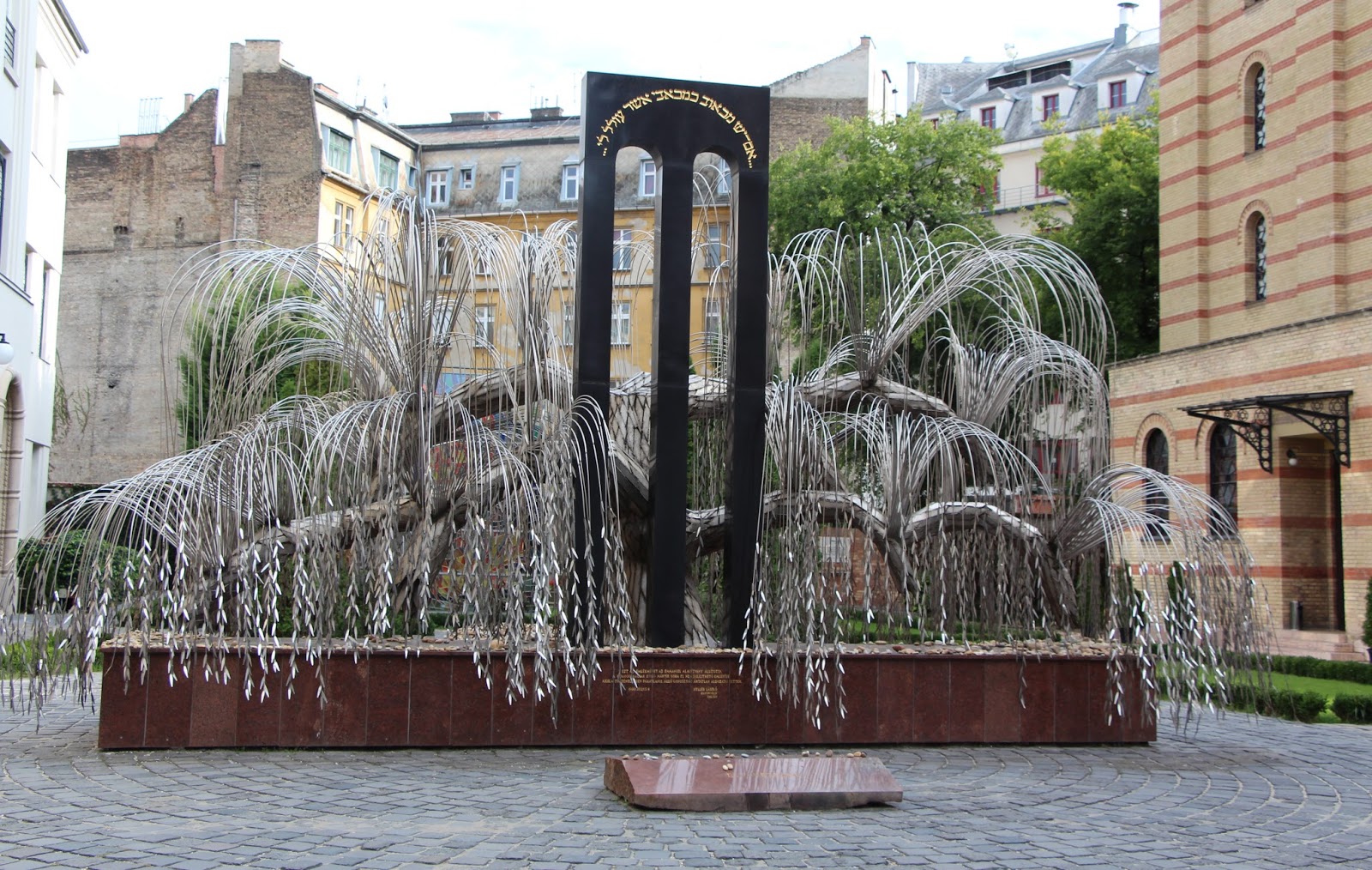
 The Emanual Tree
It’s difficult not to be moved by the Raul Wallenberg Memorial Park located alongside the Synagogue walls.  A sculpted weeping willow tree bears the names of Jewish victims of the Nazi occupation, each name inscribed on one of the metal willow leaves.  Interestingly the memorial was sponsored by the Emanual Foundation of New York created in 1987 by Tony Curtis in honour of his father, Emanuel Schwartz.

St. Stephen's Basilica
City view from the Wheel
Budapest’s neoclassical cathedral, St. Stephen’s Basilica was our final cultural stop of the day. A little gloomy inside but nevertheless impressive, a large wedding was in progress with a choir and orchestra in attendance, creating a dramatic sense of occasion.

Some mighty fine reds at DaVino
Orsi’s final culinary blow of the day was the DaVino Wine Bar across from the Basilica.  The array of Hungarian wines impressive, we enjoyed a tasting of fine reds while Orsi went home to celebrate her mother’s birthday.  We would reconvene in the morning.

Across the square a more modern attraction awaited - Felnott Jegy, a ferris wheel.  While it seemed a little out of place, the views from the top of the wheel were worth the ride.


The Parliament Building
The Chain Bridge
After a change of footwear to salve our aching feet, we ventured down to the Danube so that we could cross the iconic Chain Bridge and view the Parliament Buildings.  

Both are icons of the Budapest skyline and as daylight gave way to twilight we appreciated the reflections in the Danube emanating from the illuminated buildings. Walking back to the hotel we knew there would be no need for dinner this evening, Orsi had seen to that!

SPIRES, SQUARES AND SAUSAGES

Charles Bridge - before the hordes descended
Prague is known as the City of a hundred spires. The view from our bedroom window accompanied by the melodic sounds from the many church bells attested to that.

We had arranged to meet Alzbeta on the Charles Bridge early for a walking tour of the Old and New Towns.  

The sandstone bridge designed in 1357 for King Charles IV links the Old Town with the Little Quarter.  Thirty sculptures adorn the bridge and Good King Wenceslas features a number of times. These sentinels look down silently on the buskers and street traders that set up shop on the bridge to cater to the hordes of tourists that congregate on the bridge.  Best to get there early.

Wenceslas Square
Prague’s most famous Square is actually a boulevard. The buildings lining Wenceslas Square are a mix of architectural styles with the National Museum dominating one end of the Square.  The Museum staircase became a scene in the James Bond movie “Casino Royale” where it served as the impressive entrance to a Venice hotel.

Plaque commemorating
the 1989 Velvet Revolution

More importantly, Wenceslas Square was the scene of political demonstrations when the Soviets occupied Prague in 1968. It was also the site for the National celebration of the collapse of the Communist regime in 1989.  In an arcade tucked between Wenceslas Square and the National Theatre there is a small plaque commemorating the incident which sparked the 1989 Velvet Revolution.

All that walking made us hungry!
We were amazed at the size of the Old Town Square which began life in the 12th Century as a thriving market place.  It also served as the site for executions.  The buildings surrounding the square are stylish and impressive. Today the Square is full of outdoor cafes, vendors and street performers. The square also serves as the location for Easter and Christmas markets. 

A stall selling ham and sausages cooking tantalisingly over a spit beckoned. That along with the hot potato, cabbage and bacon salad kept us going. 

The Astronomical Clock
The Old Town Hall houses the Square’s most famous attraction - the Astronomical Clock.  The clock gives the time of day, the months and seasons of the year, the signs of the zodiac, the course of the sun and the holidays of the Christian calendar. Hugely popular, visitors wait patiently for the clock to go through its motions.

Serenity cruising the canal
Returning over the Charles Bridge, now packed, we were fortunate to be the only participants on a boat ride from the Muzeum Karla Zemana that took us along a secluded canal into the Vltava River passing under the Charles Bridge where we saw the extraordinarily high water mark from the 2002 floods.

View from the highest terrace of the Vrtba Gardens
Our feet were now barking after hours of walking but we made one last stop at the Vrtba Gardens, an Italian terraced garden created in 1715.  The gardens were immaculate and the views from the top of the terrace stunning.

After a short reprieve we made one last visit to Prague Castle followed by dinner at our favourite haunt across from St. Nicolas Church before turning our thoughts to our trip to Budapest the next morning. 

A little bonus!
We pretended it was for us
That night the sky lit up with bright light and loud bangs as a spectacular fireworks display erupted over the Old Town.  

A lovely coincidence - celebration of a wonderful stay in Prague we supposed.


Sunday, 25 October 2015

CESKY KRUMLOV - A BOHEMIAN RHAPSODY

Cesky Krumlov - easy on the eye
Several hours south of Prague lies the fairy tale town of Cesky Krumlov.  The core of Cesky Krumlov’s medieval old town is situated on a horseshoe bend in the Vltava river. Dating back to the 13th century the town played an important role in Bohemia’s network of trade routes.  

The town and castle were owned by the influential Rosenberg family but it changed hands in the 17th century when Emperor Rudolf II acquired the town. Changing hands several times again, the wealthy Eggenberg and Schwarzenberg families also left their mark.


Atop the Castle Tower
Best viewed from above, an energetic climb up the 162 steps of the Castle tower is a must do. The views spectacular.

During the communist era of Czechoslovakia, Cesky Krumlov fell into disrepair but since the 1989 Velvet Revolution the town has been beautifully restored.  


Artist in action at our lunch venue
Visitors are spoilt for choice by the charming buildings, many housing shops and restaurants.  

We enjoyed  U Dwau Marit, a riverside restaurant specializing in traditional Czech food.  With Alzbeta's guidance we sampled Kuba and roast carp, served with a dark beer produced by the descendants of the Eggenberg family.  Interestingly, carp is the dish of choice in the Czech Republic during Christmas - served with lashings of potato salad - and apparently family recipes for the potato salad are heavily guarded.

The stuff of travel brochures
The town oozes a fairytale-like atmosphere and is included on UNESCO’s list of cultural heritage sites.  The narrow winding streets of the historical centre abound with Gothic, Renaissance and Baroque buildings from the influences of the noble families that had once been in charge. 

The Castle is an impressive structure overlooking the town, filled with exquisite furniture, artwork and tapestries. There is even a gold coach on display in one of the reception halls and the Castle boasts the world’s oldest preserved Baroque theatre.

We walked MILES!
Medieval magic concluded for the day, we made a detour to Cesky Budejovice on the drive back to Prague.  The town is well known for its beer which has been brewed there since the 13th century and for a while served as the imperial brewery for the Holy Roman Emperor.

The largest brewery was founded in Cesky Budejovice in 1895 and markets its beer under the name Budweiser in Europe.  The American lager of the same name brewed by Anheuser Busch was originally created as an imitation of the Bohemian original but over time developed its own following and commercial success.  Attempts by Anheuser Busch to buy out the Czech brewing company in order to secure global rights to the Budweiser name have failed because the Czech government declared the name to be a matter of national pride and not for sale.

We purchased some product to take back to the hotel to study further. Research is everything when you travel after all.  Two days in the Czech Republic and we were feeling unusually patriotic to the Bohemian original.
   

THE CZECH REPUBLIC - UNCHARTED TERRITORY

The lines at Starbucks were long at a popular food fair in downtown Vancouver that morning back in the early 1990s.  Those patiently waiting seemed to be heavily weighted with fit looking, well-dressed young men.  One man stood out in particular for his height and physique.  It was the captain of the Pittsburgh Penguins, Mario Lemieux. 

Another young man sat by himself.  It was a young Czech, Jaromir Jagr, practising his English by reading the newspaper aloud.  Number 68 - Jagr‘s player number selected by him to commemorate the 1968 Prague Spring - went on to become the most productive European player ever to play in the National Hockey League and one of the greatest hockey players of all time.

Our knowledge of the Czech Republic was sadly lacking and we were looking forward to rectifying that.  In the meantime we dined out on Doug’s earlier encounter with Jaromir Jagr as he recounted the story many times during our stay in Prague, to the delight of those we were with.  Jagr is a home town hero and the Czechs love him and their hockey.

Sampling the St. Thomas brew in the church courtyard
Seriously jet lagged we met up with Alzbeta, our guide for the next few days.  Today’s walking tour included the Little Quarter of Prague concentrated around Prague Castle.  Our first stop, the palatial Wallenstein Gardens. Then to a rarely visited church, St. Thomas.

St. Thomas has taken “outreach” to a whole new level producing its own brew of beer for purchase from the Custodian and, if desired, a seat in a pleasant courtyard to consume it.  

The church dates back to the 11th century and is run by the Augustine Order who have turned over part of the complex for another commercial enterprise - a high end hotel.  These ventures have kept the church building in excellent repair as we appreciated the newly installed stained glass windows.

Ornate interior of St. Nicolas
We continued on to the church of St. Nicolas with its vast interior composed of marble-like fascia in a spectrum of red hues.  A giant organ dominates one end of the nave.  The church’s interior is best viewed from the upper arcade but one is cautioned not to crane one’s neck too far over the low railing as it’s a long way down to the floor below.

Alzbeta told us that the exterior of St Nicolas was featured in a Chinese movie where the heroine was married.  The movie was so popular in Asia that it attracts some brides to travel to Prague to replicate wedding photographs on the same church steps.  Advertising companies also capitalize on the venue’s popularity. The day we visited we realized the bride on the steps was actually part of an advertising shoot, her yoga pants visible beneath an exquisite jeweled bridal gown.

Trdelnik warm off the grill
As we awaited the tram that would take us up to the walls of Prague Castle we sampled Trdelnik, a warm bread hollow spiral coated in sugar and cinnamon.  This popular “fast food” is available from vendors all over the city and a tasty snack.

Arriving at Prague Castle we admired the palace gardens visiting the interior of the 16th century Belvedere Palace that had been built for the coronation ceremony of Ferdinand 1.  Now an exhibition space the former Palace overlooks a garden where tulips were first introduced to Europe from Turkey. 

We continued our walk through the expansive Castle grounds visiting the impressive St. Vitus Cathedral. This massive Gothic structure with its flying buttresses has been undergoing construction of one kind or another for almost a thousand years. 
   
Back door access between
Hotel and Castle grounds
Tiredness had overtaken us for the day.  As luck would have it our hotel has unique access from the Castle grounds for part of the day and we took full advantage of the shortcut to our comfortable bed.  The building in which the Golden Well Hotel is now situated had once been part of the Castle complex.   

Dark, creamy and delicious 
That evening we ventured down into the Little Quarter for supper in the old town hall building at the Malostranska Beseda bar and restaurant.  

The goulash and potato pancakes were tasty and the dark, frothy beer served in oversized containers excellent.  Sitting outside under the building’s decorative archways, the clanging bells of the tram cars rumbling across the ancient cobbles provided great atmosphere, the domes of St Nicolas illuminating slowly in the background as darkness fell.  

Saturday, 24 October 2015

GETTING THERE IS HALF THE FUN

How those bubbles tickle the nose!
We’ve always taken the view that a happy traveller is a flexible one.  If you live by that mantra the inevitable hiccups that arise during the journey can be taken in stride.  There are exceptions to test that rule though, like missing bags.

Our journey to Prague had started out in pure luxury. Thanks to some good friends and colleagues we were whisked to the airport in a beautiful Mercedes. Smooth!

And then the flight, courtesy of Air France.  Thanks to a seat sale we settled ourselves in 3A and 3B for the flight to Paris.  Being veterans of guests housed at the back of the plane more times than not, we really enjoyed the food, service and comfort – absolutely exceptional and provided with such style. 

Greeted with champagne, the bubbles continued to flow throughout the early part of the flight, served with imaginative appetizers - my favourite the sesame coated ahi tuna.  The bon vivant continued through a painstaking meal service and into breakfast the next morning.  A lovely experience throughout, and of course, being first off the plane.

That part about needing to be flexible, well at Charles de Gaulle reality kicked in.  On arrival a security check, a long walk, a bus ride, stairs, passport control, another security check and then finally, the boarding gate for the connecting flight on Czech Airlines to Prague.  We had a tight connection and our anxiety had been allayed somewhat because the inbound flight was early and the connecting plane was nowhere to be seen. 

Eventually a post modern 737 rolled up to the gate.  Because of our Business Class “status” on clearly what was a commuter plane we had been assigned the front seats of an aircraft that had seen better days.  Passengers trundled down the aisle eyeing us suspiciously because we were occupying an entire row of seats each and courting drinks!

Hidden away at the foot of Prague Castle,
The Golden Well.  Pure magic.  
It was a short flight but the service would put our national carrier to shame. Our battered tray tables were raised by incredibly courteous staff, covered with linen, cutlery and glassware.  No plastic for us as roast beef sandwiches appeared along with a flight attendant who wanted to make sure we were watered and fed to the maximum.  

We tried a beer and at out server’s insistence, a shot of the local herb liquor Becherovka.  He was disappointed that we couldn’t manage a second helping.  We knew the sun was over the yardarm somewhere, but we declined.  The local tipple packed a serious punch.

View from our breakfast venue at The Golden Well
An hour and a half later we arrived in Prague but one of our checked bags had not.  Not feeling so happy or flexible at this point we filed a claim and met our driver who whisked us off to our home for the next four days, the Golden Well Hotel located at the foot of Prague Castle.

We cannot say enough about the hotel and its staff.  After a warm welcome from Sasha the bellman and reception staff, the missing bag problem was taken into hand. Beyond tired we had that nagging feeling something bad had happened to the bag languishing in Paris.  And of course, it had to be the bag with our dress up clothes for the palatial evening that had been promised in Vienna. What no jacket, no tie?  And madam, sandals?  Are you serious?

All set for the journey from Prague to Budapest 
Stay flexible kids. The next morning the bag that had gone walkabout arrived.  Cinders, you will go to the Ball after all!  Negative thoughts banished we set out to spend a wonderful few days in Prague, including a day out to Cesky Krumlov.

Four days later we ventured to the main railway station for the 7 hour train trip to Budapest.  The railway station was awash with passengers and luggage, all eyeing the departures board for their particular train’s assigned platform.  A busy place but our anxiety about the organized chaos was unfounded.  

A gruff porter was actually very helpful and we boarded the Euro City Slovan service to Budapest with relative ease.

That will put hairs on your chest ....
An hour into the journey we sipped our espresso served by an attendant at our seats, along with newspapers and water.  

We watched the countryside whisk by, the train smooth as silk on the rails.  

The thought of record low water levels on the Danube and whether our riverboat would be able to fulfill its itinerary a problem for another day.