Thursday, 25 April 2019

PANAMA HATS COME FROM ECUADOR, ONE OF LIFE'S LITTLE IRONIES

Vessels under repair and construction
lolling on the shoreline
Manta is Ecuador’s second port after Guayaquil with its primary industry vested in fishing, tuna canning and processing. BC Packers has a sizable plant in Manta.

One of Manta's beachfront markets
The town has an impressive esplanade that provides great views over the harbour and ocean beyond.  Colourful fishing boats bobbed in the water.

It created a festive ambiance, locals were out shopping, returning to the fish plants for the next shift, working on beached fishing boats or simply enjoying the beautiful day in the open air cafes.

Cancebi Museum window
The restored Cancebi Museum in Manta's town centre was remarkable, not so much for its eclectic exhibits but for its construction.
It ain't half hot Mum!

Richly polished squeaky floors flanked by elegant shuttered windows, solid mahogany ceiling beams that supported large bladed fans.  The blades whooped languidly in what seemed like a half-hearted attempt to move the oppressive air. Even the iguana on the sidewalks below looked exhausted. 

The sun was directly above, reminding us of our equatorial position.

The production line!
Cabuya weaving 
A drive out of town took us to the Cabuya weaving factory where natural fiber is stripped from the Fique plant, Furcrea Macrophylla, and processed into woven bags.

The gloomy collection of rooms with their dank whitewashed walls and uneven concrete floors seemed set in another century as workers laboured away on the ancient equipment that clacked and hissed in protest.

The facility is the last remaining one in the region and produces 200 woven bags a week for the coffee industry, the roasting aromas from the surrounding processing plants a subtle reminder of one of the drivers of the local economy.

Another discovery that day was an unusual palm tree, Phytelephas Aequatorialis, commonly known as Ecuadorian ivory palm and the main source of vegetable ivory or Tagua, the botanical alternative to ivory. Growing in the tropical rainforests of Ecuador, the palm has a woody trunk with very long pinnate leaves and can grow to a height of sixty feet.

Tagua nuts were originally used in the production of buttons because of their hard, white consistency. While button manufacturing still provides the main source of income for the local cottage industry, realizing its touristic value the locals have fashioned the nut into all sorts of carvings, jewelry and of course bags of buttons.

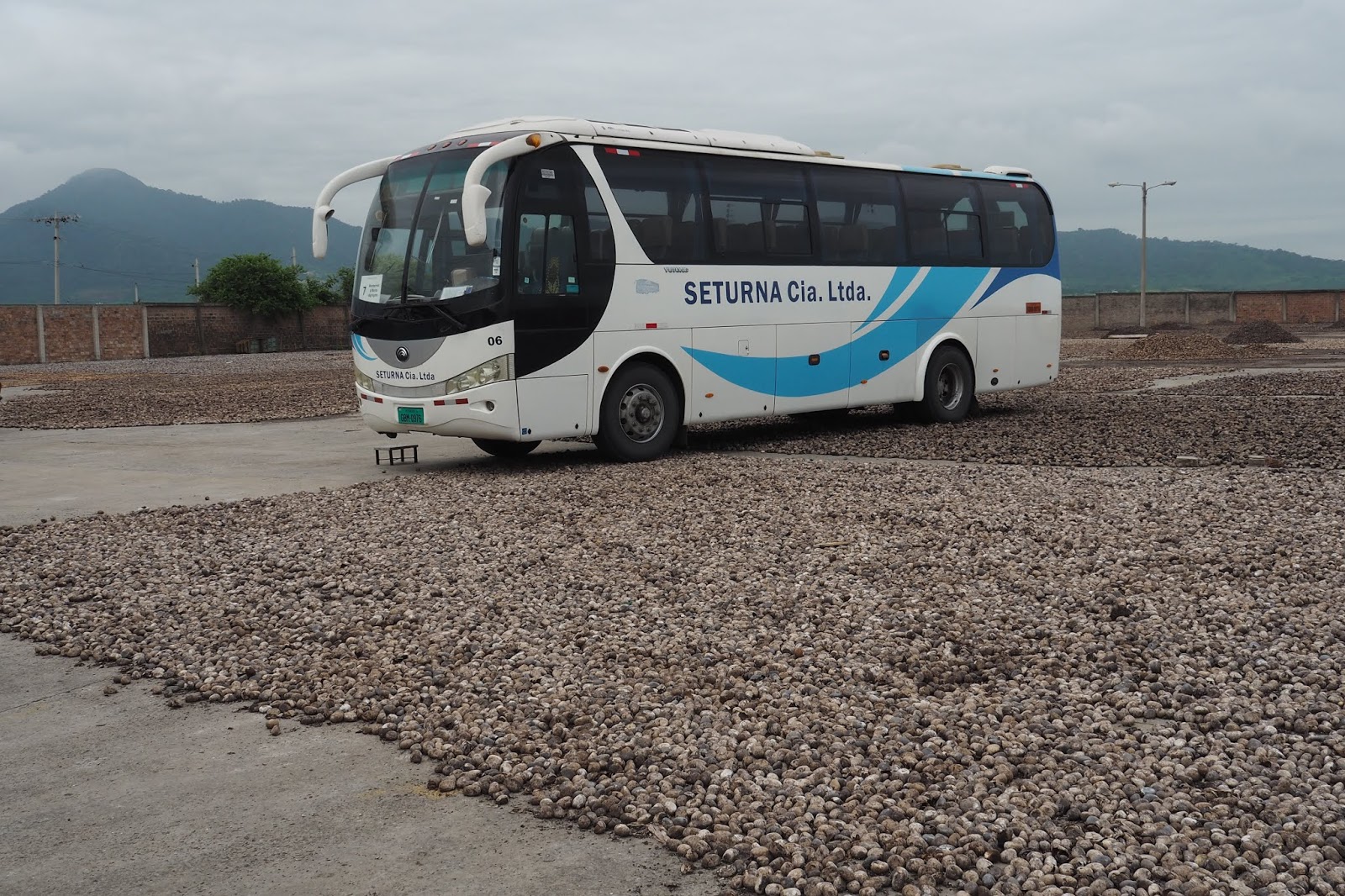
The parking area outside the workshop was awash with Tagua nuts drying in the sun.

The nearby town of Montecristi was buzzing with activity, the local market doing a fine trade. 

Montecristi is known for the artisans who fashion straw from the leaves of the indigenous Carludovica Palmata plant into Panama hats. 

The steps that go into the creation of an original Montecristi Panama hat is a sight to behold. From leaf preparation to weaving to the finished product, there are different grades of hat.

One can spend $20 on a coarsely made product and as much as $200 for a well-fashioned, intricately woven hat. As luck would have it we had purchased our Panama Hats in Quito eleven years ago, a must have from this part of the world!

Tuesday, 23 April 2019

THE PANAMA CANAL - LOX WITH OUR LOCKS

Panama City on the Pacific Ocean
at sunrise
Great vantage point from our
stateroom overlooking the bridge
Comfortably seated for the
morning's proceedings
In 1987 we transited the Panama Canal on our very first cruise.

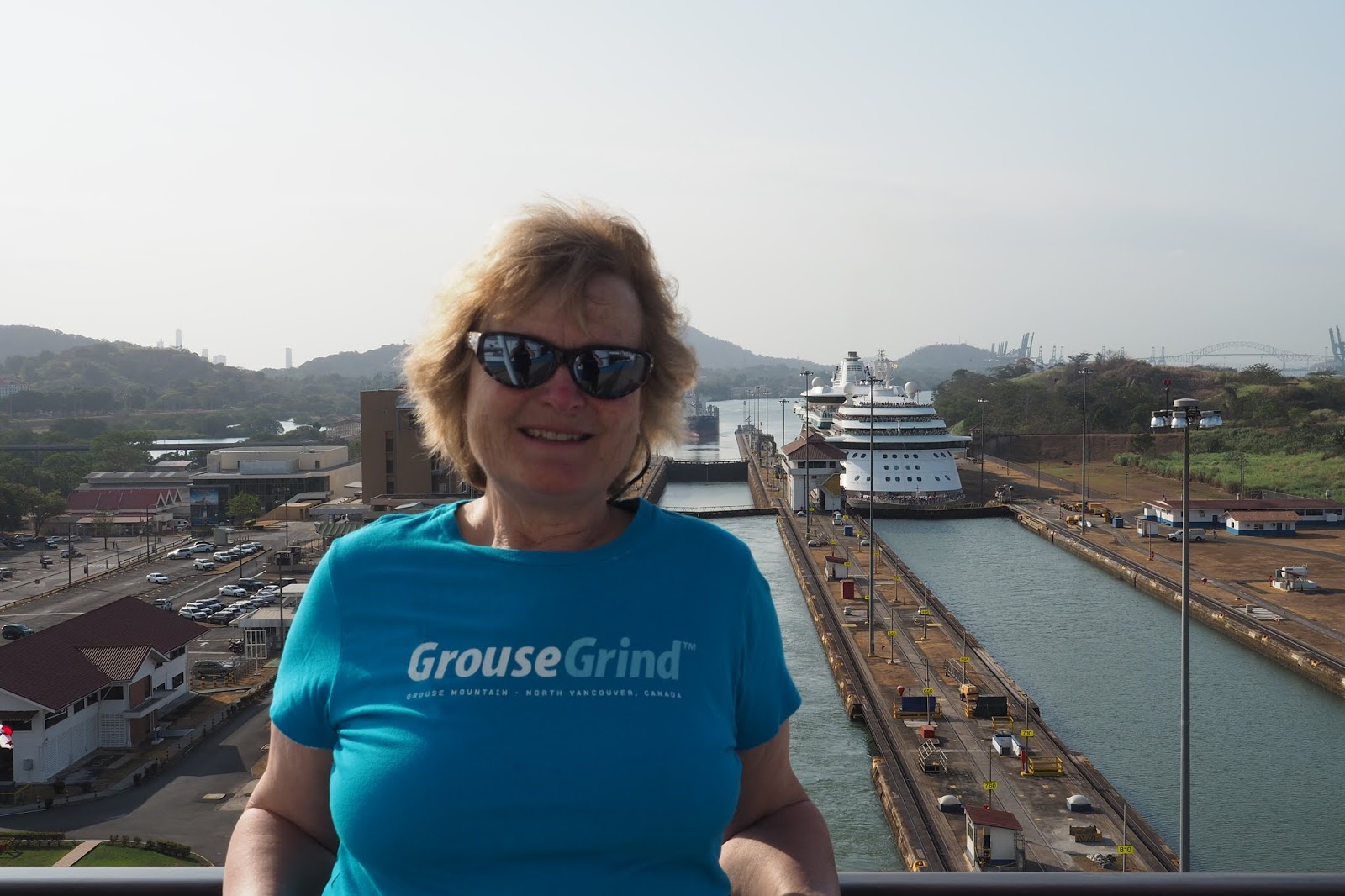
We’d always wanted to repeat the experience and here we were again at the port of Panama at daybreak as a ball of orange rose in the sky casting dramatic silhouettes over the profusion of skyscrapers and the Bridge of the Americas.

The Miraflores Locks and the new Cocoli Locks
out of sight but off to the right
Maybe at this point in our lives we are a little more switched on because back in 1987 we hadn’t appreciated the accomplishment of building a ship canal across the Isthmus of Panama from Pacific to Atlantic by digging through the mountains of the Continental Divide, constructing the largest earthen dam ever built at that time, building the most massive locks ever envisioned, constructing the largest lock gate ever swung and addressing sanitation and environmental problems of massive proportions.

Exiting Miraflores Locks en route to the Pedro Miguel Locks
and the Culebra Cut, Bridge of the Americas on the horizon

The Panama Canal is undoubtedly one of the world’s greatest engineering accomplishments.

A fifty mile waterway from north to south, ships enter the locks on one side of the Isthmus, are raised in several steps to 85 feet above sea level, then lowered through more locks to sea level on the other side.

The complete transit takes between 6-8 hours.

After a failed attempt by the French, the US took on the task of building the Canal between 1904 and 1914.

The workforce was immense, the death toll from malaria and yellow fever shocking.

Large container in transit through the new Agua Clara Locks
to the right of our position in the Gatun Locks below
While the US controlled the waterway and large sections of surrounding land Panamanians resented the existence of what was known as the Panama Canal Zone and eventually in 1999 President Jimmy Carter authorized a treaty that ultimately recognized Panama’s control and ownership.

Two new lock complexes on each side of the Isthmus were completed in 2016. Designed for larger vessels the expansion has doubled the Panama Canal’s capacity.

From daybreak to late afternoon we were transfixed by the goings on. Dear Akshay brought breakfast to our stateroom while we sat on our balcony and watched the goings on.

A little champagne, fruit, lox and bagels seemed appropriate for such an auspicious occasion.

A large Royal Caribbean cruise ship followed us and it gave great perspective as we watched its progress rising and falling in the locks behind us, its decks thronged with passengers all enjoying the experience, just like us.
 
Exiting the Gatun Locks into the Atlantic Ocean, our transit complete
we continued to watch the Royal Caribbean vessel's progress

DAY "O" IN COSTA RICA


Friendly locals display their catch
The tropical rain bounced loudly off the rickety tin roofs of the makeshift dwellings that lined the appallingly potholed streets on the outskirts of Puerto Limon.


We were on our way to Tortuguero's impressive network of canals.


The rain eased as we navigated the meandering waterways, the mangroves thick along the banks with verdant tropical greenery cascading over the water.

The place was teeming with life - "the seen and the heard".

A true banana boat
Confiscated boats lay rotting in the watery undergrowth, taken from drug runners by the local Coast Guard, one in particular caught our attention, a banana laden tree growing vigorously in its aft. Bringing a whole new meaning to banana boat.

During the 20th Century the railway gave birth to Costa Rica’s banana industry and while the train system has languished, one restored open air train chugged us through the rain forest.

The howler monkeys above us a sight to behold, animated and noisy. And aptly named.


Puerto Limon has a congestion problem, the amount of container traffic is astonishing. Trailers clog the highway and the thought is to establish a “dry canal” from Pacific to Atlantic coasts, essentially a high speed train that will move commerce more efficiently and end the gridlock.

The rain returned and while warm, we were grateful for the dry break in the weather during our short visit to Costa Rica’s Atlantic coast and the incredible birds and animals of its rainforest.

LIFE’S A BEACH, AT LEAST MOST OF THE TIME

Costa Maya, Mexico
The three day power outage last December and the snowy winter that followed was starting to feel like a thing of the past after a day in the sultry heat of Santo Tomas, Guatemala, the heartbeat of Mayan civilization. The people so warm and approachable and the Mayan culture indelibly imprinted on their faces.

Our day on Roatan Island, Honduras was certainly one to remember as we snorkeled in the clear blue water with schools of cobalt coloured fish darting amongst the coral below us. In ten feet of water we swam to the edge of the reef where the drop off to the ocean floor plunged us into darkness. Time to retreat after so much excitement to laze in the turquoise coloured lagoon.

Stress free on Roatan Island
All alone at the Costa Maya
beach resort
Harvest Caye, Belize is a man made affair designed for cruise ship passengers, its facilities spotlessly clean yet sterile. Not really our style, we checked out the pristine beach cabanas and decided the only natural thing about this place was the jellyfish.

The facilities back on board Marina were much enjoyed that day, including Paolo’s latte magic in the a/c as the external temperatures hit the high 30s.

Puerto Costa Maya on Mexico’s Caribbean coast proved to be a pleasant surprise. While this too is an exclusive facility designed for cruise ships it was fortunate we were the only ones in port to soak up the bluest waters we have ever seen flanked by miles of gorgeous sandy beaches.

Our beach day was perfect and it was hard to pry ourselves away from the soothing surf, singing birds and silky sand that enveloped our toes.

The staff wanted to blast out loud music but we reached an agreeable compromise.

Moody tunes that seemed to blend perfectly with our environment became the order of the day, along with a couple of refreshing, ice cold cervezas. Not bad, and snow removal not required!

SOBE POSING - WHAT, IN THESE SHOES?

When you are told to expect the world’s largest collection of art deco buildings resplendent in their sorbet colours, well!

A wander along South Beach’s Ocean Drive offers so much more than its impressive architecture.

Curbside restaurants spill out on to the sidewalks, their patrons shaded under colourful umbrellas. 
Miami Beach

The ivory coloured beach stretches for miles in either direction, adorned with brightly coloured umbrellas and wind breaks.

What's it to be, a reading or a latte?
We confess that people watching did rather compete with our enjoyment of the colourful architecture.

Contradictions all around us.  Doug did ponder for a while as he looked at the wares of a South Beach Psychic and then thought an ice cold latte at the Starbucks across the street might be a better bet.

And suntanned flesh
High end cars aplenty
The Ocean Drive curb crawling Ferraris and Maseratis moved at a snail's pace, while the sauntering young things ambled lazily this way and that in the skimpiest of clothing.

We had not appreciated the fact that mini hot pants are enjoying a resurgence, some sported with an open zip so that one’s bejewelled naval can sparkle in the sun. Tattooed buttocks seemed to be everywhere, some more attractive than others. All this hidden behind over sized Jackie O sunglasses so that the watched can become the watchers. It seemed that everyone was striking a pose of some kind.

The former Versace mansion
The former Gianni Versace mansion, Casa Casuarina, dominates Ocean Drive.  Built in 1930 in Mediterranean Revival style, Versace bought the property for $2.95 Million in 1992 but the last time it changed hands in 2013 it sold for $41.5 Million and now operates as the Villa Casa Casuarina, a high end boutique hotel and restaurant. The structure and its gardens exude elegance and style.

Versace was infamously gunned down on his own front doorstep in 1997.

Meanwhile the Cuban American restaurant staff along the strip hustled for business, their ebullient Spanish banter and easy smiles welcoming from the hot sun.

Simply not engineered for snowbanks
Everything is super sized here
Our greeter for a cold beer sojourn sported awkward looking red high heels which she insisted were like slippers as she stalked the sidewalk in search of more customers.

She told us she had originally settled in Canada from Cuba but couldn’t hack the winters. Now she was expressing her frustration with the South Beach heat. However, she did agree that SOBE permitted enjoyment of her red shoes twelve months of the year. 

Monday, 22 April 2019

THE CITY THAT NEVER SLEEPS, BUT VISITORS NEED TO

Sailing into New York
past Lower Manhattan
The Statue of Liberty - an
interesting vantage point
New York City is one of those places that never ceases to amaze. Despite the aging infrastructure of its subways and sidewalks, the city's beating heart pounds subliminally like a drumbeat in one's consciousness. Whether its a Broadway show, a walking tour around Brooklyn Heights and DUMBO, appreciating masterpieces like Van Gogh's "Starry Night" or paying respects at the 9/11 Memorial, there is so much to see and experience, as long as the body is willing. But planning one’s time well is critical. There isn’t a moment to be lost experiencing this pulsating place.

Coming into the Manhattan Cruise Ship Terminal. 
Hudson Yards and the Empire State Building on the skyline
We had reached the end of a cruise that had begun in Peru several weeks earlier and had planned an extended stay in the final port of call, New York City. The sail into the harbour was picture perfect as we passed the Statue of Liberty and Ellis Island, the focus of a previous visit several years before.

Enjoying the High Line
Once docked, our first expedition was a vigorous walk to Times Square to check out our hotel's location.  

Spring has just about sprung
on the High Line
Next stop after a short subway ride, the High Line. Originally an abandoned elevated railway, the area now encompasses an attractive walkway of gardens and seating set among the rusting railroad tracks above street level.

At one end the Chelsea Market, a serious assortment of shops and eateries in the former Nabisco warehouse, a lovely old brick building. At the other end, Hudson Yards, composed of the most expensive real estate in North America, and still growing. In the midst of its towers of glass and steel, a bizarre bronze structure titled “the Vessel” rests, providing amazing views from its peak over the Hudson River and beyond.  And not that far from where Captain Sully famously landed his aircraft in the water after that near fatal bird strike.

A 30 minute ride from point to point
One of New York City’s best kept secrets is the Staten Island Ferry, a free service from the tip of Manhattan to the City’s smallest borough, Staten Island. The service is efficient, the views of the Statue of Liberty, Ellis Island and Lower Manhattan free.
Installed in our Times Square hotel, the following day’s activities were certainly ones of remembrance. It began overlooking the memorial pools of the fallen World Trade towers. It’s hard to describe the reaction one feels. The site is somber, sad and moving. Almost 3,000 names of those lost in the 11 September 2001 North and South towers, the passengers of the four downed aircraft, and the victims of the 1993 World Trade Centre parkade car bombing line the perimeter walls of each commemorative pool. Most poignantly, a rose is placed alongside the name of each victim on their birthday.

Taking in the views over
lower Manhattan and Brooklyn
Three floors form the viewing area
starting at the 100th floor
The post 9/11 Freedom Tower built to a height of 1776 feet to mark the date of the Declaration of Independence looks down imposingly over the tranquility of the commemorative pools that fill the footprints of the former twin towers. Now known as One World Trade Centre, a supersonic elevator ride whisks one a 100 floors in no time. The views over the city really are spectacular and we were lucky to have a clear day.

The slurry wall that holds back the Hudson River and the
final girder salvaged from the wreckage of the fallen towers
However the 9/11 Memorial Museum is an experience not to be missed. Situated underground on the footprint of both towers, the displays include all manner of memorabilia as well as equipment salvaged from the site. A crushed fire engine, a mangled elevator motor, part of the twisted antennae from the tip of the North Tower and part of a pulverized staircase down which many had managed to escape. 

Perhaps most striking, the slurry wall built as part of the original North Tower construction in order to contain the Hudson River. Had this wall failed during the 9/11 attacks, the entire subway system would have been flooded. A small victory of sorts: 17,000 people were working in those buildings that fateful day. Sadly 40% of the families that lost a family member still have no body, no visible proof of what happened to their loved ones. The DNA work continues in an area adjoining the Museum. And then you realize the aluminum coloured walls on one side of this subterranean world are the containment walls for the memorial pools at street level. Altogether an astonishing experience of sadness, hope and remembrance.

That evening the final piece of 9/11 remembrance. Gander, Newfoundland and all those diverted aircraft. The Broadway production of “Come from Away”. The stirring, heartfelt performance had the packed house on its feet.

An energizing walk over the Brooklyn Bridge
Manhattan from Brooklyn Heights
The next morning was clear and sunny and perfect for a morning
walking tour over the Brooklyn Bridge to Brooklyn Heights and DUMBO (down under the Manhattan Bridge Overpass). 

Our guide, a native Brooklynite regaled us with stories of the superiority of Brooklyn over Manhattan, discussed the bridge’s interesting construction history, pointed out landmarks on a 360 degree scale and explained the architectural make up of the attractive Brooklyn Heights community. The ambiance couldn’t have been in greater contrast to the hustle and bustle of Manhattan. The calmness was palpable with residents walking their dogs, enjoying coffee in sidewalk cafes and chatting on street corners.

Down at DUMBO the atmosphere was almost festive with restaurant patrons spilling out onto the street. The pizza vendors here have earned their reputation for thin crust pizza however it is apparently a serious transgression to request pineapple in any form on one’s pizza.

An express subway ride took us from Brooklyn up to Central Park and the spectacular Metropolitan Museum of Art. The building itself is extremely imposing with an eclectic and incredibly impressive collection. We were there for the European painters but sadly an attendant told us that while the Museum had a series of Van Gogh paintings, Starry Night was not among them. We were in the right city but at the wrong Museum!

After a planning meeting later that evening over Harp lager in an Irish pub off Times Square we devised a plan. We were flying home the next day but had a small window to get to the Museum of Modern Art where Starry Night was on display.  The walk uptown the next morning was well worth the last minute effort.

Starry Night by Vincent Van Gogh
Olive Trees by Vincent Van Gogh
Starry Night is alive with colour and texture, and interestingly, while it was the subject of a view from the asylum that Van Gogh had retreated to, also on display is one of his many paintings of the trees in the olive garden viewed through another window. The blending of blues, greens and cream quite breathtaking. We were amazed that we had been permitted to get so close to such expensive real estate. Starry Night is valued in excess of $100 Million!

We had been on the move the entire time of our New York City stay. No shortage of things to see and experience in the city that never sleeps.